The Markdown Rebellion
The university ran on a legacy ERP. Had for decades. Four of them, if you're counting. The system was older than the person who maintained it by almost ten years and nobody joked about this anymore because the joke had calcified into something closer to grief.
Every seven years, like cursed institutional clockwork, the cabinet would gather and someone would say the words everyone in the room dreaded.
"It's time to upgrade the ERP."
And so it would begin. The tens of millions in budget. The 36-month timeline everyone privately knew was actually 60. The army of consultants and wannabe VCs in matching Patagonia vests. The "change management" workshops where staff were taught to click buttons in a system that hadn't been built yet, one that would, once again, tell them how to work.
The students never noticed any of it. They still couldn't get a straight answer about their transfer credits. Advisors still copied data from one screen and pasted it into another. The "student experience" was still a PDF attached to an email sent from a no-reply address.
The data lived inside the ERP like a dragon sitting on gold. Technically it was there. Practically, nobody could touch it. And the dragon was written in COBOL-adjacent logic that predated the browser, dial-up, 1200 baud, NNTP, USENET, Gopher, and the good old finger.
If you work in higher education, you already know this story. You're living it. Maybe you're in year two of a five-year implementation right now. Maybe you just finished one and you're dreading the next cycle. Maybe you're the person maintaining the system that's older than you are.
This is for you.
A few weeks ago I walked into a leadership workshop and did something nobody expected. I didn't open a slide deck. I didn't pull up a vendor demo. I opened a terminal inside an open-source note-taking app and typed /today.
What came back wasn't a calendar. It was a briefing. My calendar, yes — but also the news that mattered to my role, the context behind my first three meetings, a reminder about a follow-up I'd promised someone last Thursday and already forgotten, and a read on market signals relevant to a decision I was making that week. All of it assembled in seconds. All of it in plain text. All of it built by an agent I'd taught to read my world — by describing my world in markdown files.
The room got quiet the way rooms get quiet when someone shows you something that makes your current tools feel like cave paintings.
I built the thing with Claude in a few hours. It reads a handful of markdown files that describe my role, my priorities, my current projects, my communication style, even what I don't want to be bothered with. Every morning it assembles a briefing that's smarter than any dashboard I've ever used — because it doesn't just show me data. It shows me what matters today. Like a daily vitamin for the brain.
The /today script pulls from calendars, email, news feeds, social networks, institutional data. But the magic isn't in the pulling. The magic is in the describing. I wrote the markdown that tells the agent who I am, what I care about, and how I think. The agent reads those files every morning and uses them as the lens through which everything else gets filtered.
Then I said the thing that changed the room.
"Now imagine every person on your leadership team has one of these. Their own daily briefing, tuned to their role, their priorities, their decisions. The provost sees enrollment signals and board prep. The CFO sees budget variances and vendor contract triggers. The CIO sees system health and security posture. The dean of students sees advising load and stop-out risk. Each person gets their own intelligence briefing — personalized, contextual, delivered before their first cup of coffee."
Someone asked the good question. "But those are all separate views. How does that help us think together?"
I smiled. Because this is where it stops being a productivity hack and becomes something else. Every one of those daily briefings gets committed to a shared repository. The team's repo, the team's brain. And now you've got something that sounds like magic and will be table stakes within a year — a multi-dimensional intelligence layer where every leader's daily context feeds into a collective memory. An agent reading that repo doesn't just know what the provost saw this morning. It knows what the provost saw and what the CFO saw and what the CIO saw. It can surface connections none of them would have caught alone. The enrollment dip the provost flagged lines up with the CRM outage the CIO noted lines up with the budget variance the CFO is tracking. One repo. Many perspectives. Intelligence that compounds every single day.
By the end of the workshop, every leader in the room had their own /today. It took forty minutes. Not forty days. Not forty consultants. Forty minutes and a text editor. As close to free as software delivery gets.
And then someone on that team — maybe me, maybe someone I'd infected with the idea — did the next unremarkable thing. They created a file called institution.md.
# Our University

## Identity
- Type: Private, non-profit
- Focus: Adult degree completion at scale
- Differentiator: AI-native operations
- Population: 42M Americans with some college, no degree

## Programs
- Active: 87 undergraduate, 34 graduate
- Fastest Growing: Data Science, Cybersecurity, Nursing
- Modality: 78% online, 22% hybrid

## Transfer Policy
- Accepts: CLEP, AP, military, prior learning
- Average incoming credits: 47
- Evaluation SLA: 48 hours target, 11 days actual
Just text. Flat. Readable by a human with zero training. Readable by a machine with zero integration. Same format as the daily briefings — but describing not a person, an entire institution.
Nobody approved it through governance. Nobody filed a ticket. Nobody waited for IT to provision a sandbox. They just described their world. In plain language. And saved the file.
The enterprise architect saw it first and did what enterprise architects do. "This isn't how enterprise architecture works. Where's the schema? Where's the data dictionary? You can't just describe things in a text file and expect that to power operations."
He was asking the right questions for the wrong century. Because the daily briefings had already proven the model. Markdown files describing a person's world had produced intelligence that felt like magic. Markdown files describing an institution's world were about to produce something bigger.
We pulled up a diagram. Four planes, drawn as simply as the markdown itself. Each one doing exactly one job. None of them entangled with the others.
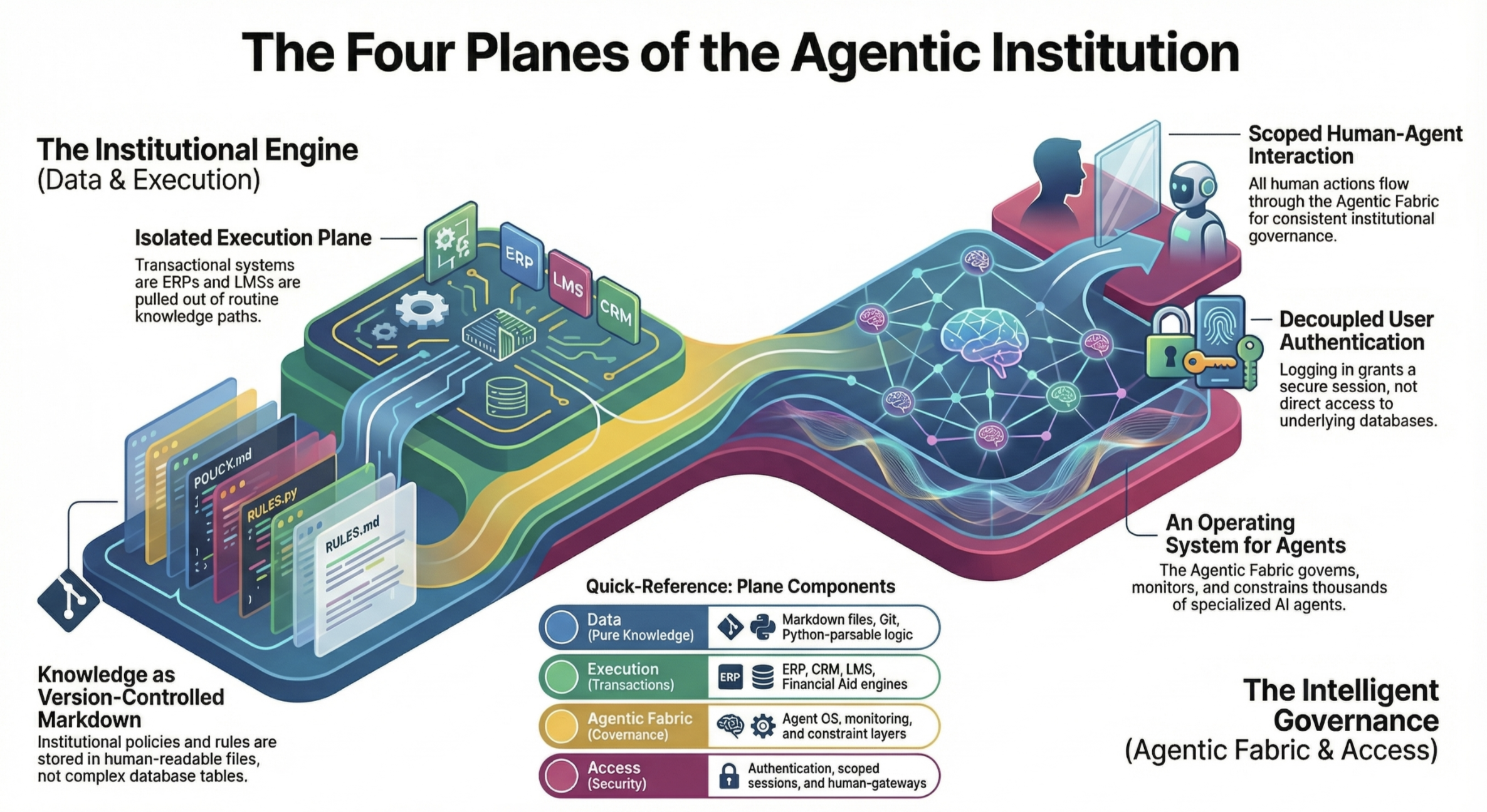
The Data Plane. Markdown. Human-readable files. Version-controlled in Git. Describing the institution not as database tables but as knowledge. Programs, policies, student segments, transfer rules, advising logic, intervention thresholds. All of it in files a dean can read over coffee and a developer can parse in three lines of Python. Nothing executes here. Nothing runs here. It is pure knowledge, pure description, pure context.
The Execution Plane. Databases. Applications. Transactional systems. The ERP. The CRM. The LMS. The financial aid engine. The systems that actually do things — post credits, charge tuition, generate transcripts. This plane already existed. It always existed. The breakthrough wasn't replacing it. The breakthrough was isolating it. Pulling it out of the path of routine knowledge access so it only gets touched when an actual transaction needs to occur.
The Agentic Fabric. An operating system for agents. Not one agent doing one thing — an environment where hundreds of them get spawned, governed, monitored, and kept in their lane. What each one can do, what it can read, who it answers to. The fabric is to agents what an OS is to processes. It's what makes a thousand specialized agents safe to run at the same time, on behalf of the same humans, without stepping on each other or escaping their boundaries.
The Access Plane. Authentication for humans. Separated entirely from the execution and data planes. When a registrar logs into her workstation, that single act of authentication does not automatically grant her direct database privileges or unfettered query access. It grants her a session. From there, anything she actually wants to do flows through the agentic fabric, with the same scoping and governance that applies to every other actor.
I let that last point sit. Because it's the sentence that actually changes the stakes.
In the old world, your login was the keys to the kingdom. Compromised credentials meant the attacker became you — same access, same privileges, same blast radius. Now? Compromised credentials buy an attacker a session in the access plane. That's it. To actually do anything, they have to operate through a fabric that checks cryptographic identity at every hop.
Stealing a credential doesn't get you into the kingdom anymore. It gets you a chair in the lobby.
Four planes. Four jobs. None of them carrying the others' risk. That's the whole point.
We started small. One file became ten. Ten became a repository.
/institution
  /identity
    mission.md
    accreditation.md
    strategic-plan.md
  /programs
    bsn-nursing.md
    ms-data-science.md
    bs-cybersecurity.md
  /policies
    transfer-credit.md
    financial-aid.md
    academic-standing.md
  /students
    segments.md
    stopped-out-profile.md
    intervention-triggers.md
  /operations
    advising-workflows.md
    enrollment-funnel.md
    sla-targets.md
Each file followed a pattern. Context a human could audit. Structure an agent could consume. No proprietary format. No vendor lock-in. Fork it, version it, diff it, review it like code.
But the knowledge that should live in those files was trapped. Scattered across the ERP's COBOL-era tables. Across the CRM's object model. Across shared drive folders that hadn't been opened since 2019. Across the heads of staff who carried institutional memory that had never been written down.
Getting it out required a data mining layer. An engine that could crawl institutional data sources, catalog what existed, figure out how it all related. It reached into the ERP's cryptic table structures, the CRM, the LMS, the HR system, and pulled out not just data but meaning. Then it wrote what it found as markdown. Plain language. The kind both humans and agents could read without a translator.
## Transfer Credit Evaluation (Source: ERP + CRM)
- Current avg evaluation time: 11.3 days (SLA target: 48 hours)
- Bottleneck: Manual equivalency lookup in legacy tables
- 73% of incoming transcripts contain credits with existing
  equivalency mappings that could be auto-evaluated
- Top 5 feeder institutions account for 61% of transfer volume
The data mining layer was the bridge. The institution as it was, locked inside legacy systems, and the institution it was becoming, described in plain language, ready for agents to read.
The transfer-credit.md file didn't just list policy. It described intent.
## Transfer Credit Philosophy
We believe credit is earned by the learner, not owned by the
institution. Our default posture is acceptance. Denial requires
justification. The student should never have to prove their
learning twice.

## Evaluation Rules
- Military transcripts (JST): Auto-accept per ACE recommendations
- Regional accreditation: Accept if C or above and course aligns
- CLEP: Accept per published score thresholds
- Prior Learning Assessment: Portfolio review within 14 days
An agent reading that file didn't just get data. It got values. It understood that when a student asked "will my credits transfer," the institutional posture was yes, let's figure out how — not submit your transcripts and wait.
The first agent went live on SMS. A stopped-out student named Maria, three years gone, got a text.
Hey Maria, this is your university. You finished 47 credits before life got in the way. That's real progress. We've looked at what you completed and you're closer than you think. Want to see what a path to your degree could look like? No pressure. Just information.
Maria replied: how do you know my credits
The agent — reading the stopped-out profile, the transfer credit policy, the enrollment funnel — knew what to do. It didn't say "our system of record indicates." It said:
We kept your academic record safe. 47 credits, mostly in your general education core. A few in your major. If you came back, you'd likely be starting as a junior, not a freshman. Want me to map it out?
Maria replied: ok show me
Within 90 seconds, the credit evaluation engine handed off to a degree mapping engine that took Maria's specific credit profile and turned it into a visual degree path. Which courses transferred. Which requirements they satisfied. What remained. What her first semester back would look like. What other programs her credits might also qualify her for.
It sent the whole thing as a link. No login required. No portal. No password reset for an account she'd forgotten existed.
When Maria clicked that link, she didn't land on a generic university webpage. An agentic web layer had already built her a personalized page. Her credits. Her likely program. Testimonials from adults who'd come back after similar gaps. Faculty she'd actually have. Her first two semesters of courses, evening and weekend options up front, because the stopped-out profile markdown said working adults need flexible scheduling.
The registrar's office didn't get a ticket. The ERP didn't get an API call. Maria got a picture of her future, built from flat text files and agents that could read them.
Describing the institution in markdown was only half the idea. The other half was describing the learner.
Somewhere inside the ERP, Maria Smith existed as Student ID 20190847. Inside the CRM, she was Contact 003Dn00000XkR91. Inside the LMS, she was msmith47. Inside the financial aid system, she was an ISIR record from 2019. Inside career services, a row that hadn't been updated since she stopped out.
Five systems. Five identities. Five partial views. No single system held the whole Maria. No human could see her complete picture without logging into all five and stitching it together in their head.
The data mining layer changed that. It crawled the systems. It resolved the identities. And then it did the thing that made everyone in the room go quiet.
It wrote a file.
# Maria Smith
## Learner Profile (assembled: 2026-04-01)

### Academic Record
- Credits earned: 47
- GPA at departure: 3.1
- Program: BS Business Administration
- Gen ed complete: 78%
- Major requirements complete: 22%

### Skills (extracted via skills intelligence engine)
- Accounting fundamentals (from ACC 201, 202)
- Business communications (from BUS 301)
- Statistics and data interpretation (from MTH 240)
- Workforce alignment: 73% match to "Business Analyst" roles
  in her metro area (BLS data, updated quarterly)

### Engagement History
- Last institutional contact: Automated email, March 2022 (no reply)
- Preferred channel (inferred): SMS
- Outreach window: Evenings after 6pm (prior login patterns)
- Opportunity flags: High completion probability (47 credits,
  3.1 GPA, $0 balance)

### Intervention Recommendation
- Trigger: Re-engagement via SMS
- Lead with: Credit preservation message
- Follow with: Instant credit evaluation → degree map
- Do not lead with: Financial aid (no outstanding balance —
  money wasn't her barrier)
- Escalate to human if: She mentions childcare, health,
  or expresses doubt about ability to succeed
There it was. maria-smith.md. A single file. A complete view of a human being's relationship with the institution that no single system had ever held.
This wasn't a dashboard. Dashboards are built for humans staring at screens. This was a data product built for agents. An agent reading that file didn't need to query five systems. It didn't need API credentials to the ERP, the CRM, the LMS, the financial aid system, and the career services database. It needed one file. And that file gave the agent something no ERP had ever provided: Maria as a whole person. Not rows. Not fields. A life described in language that carried context and intent and the institution's own values about how to treat her.
The file told the agent what Maria had done. What Maria might need. And what not to do — don't lead with money, because money wasn't her problem.
The institutional markdown described the university. The learner markdown described a person. And the agentic fabric sat between them, making sure the connection was governed and auditable. Agents proved identity before touching data. Access was scoped to the minimum necessary. Handoffs between agents were verified. The whole chain of custody, preserved from first contact to final action.
And because it was markdown, it could travel with the learner. Maria's credits, skills, engagement patterns, career alignment — none of it locked inside institutional infrastructure. It was a portable file. With Maria's consent, she could hand it to an employer, a graduate school, any future institution running the same fabric.
The record belonged to the learner. The institution was its steward. The fabric enforced the difference.
The seven-year cycle came around again. The provost gathered the cabinet.
"It's time to—"
"No."
The room went quiet.
"We don't need to upgrade the ERP. We need to upgrade our description of ourselves. The programs we're launching next year. The student segments we're targeting. The transfer policies we're changing. None of that lives in the ERP. It lives in the repository. Updating a markdown file costs us nothing. Takes us an hour. And every agent in the fabric sees the change immediately."
The $40 million ERP upgrade became a $400,000 annual investment in describing the institution to itself. The 36-month implementation became continuous deployment of new agent capabilities, each one reading the same growing repository.
But something else happened, and it was bigger than the ERP decision.
Call it the SaaS dimmer switch. Once the data plane lived in markdown — once the institutional knowledge was portable, versioned, and owned — every SaaS vendor in the tech stack suddenly existed on a spectrum. Not a binary "we use it or we don't." A continuous dial. Turn it up when it was earning its keep. Turn it down when it wasn't. Turn it off entirely when a better option emerged or the vendor got greedy at renewal time.
Every SaaS product had been generating intelligence — usage patterns, configuration choices, business rules, workflows — that the vendor treated as theirs. Locked inside their UI. Accessible only through their proprietary reports. The intelligence you paid to create was being held hostage inside the tool you were paying to use.
The data mining layer changed that equation. It reached into any SaaS product and extracted the institution's knowledge out of the vendor's walled garden and into markdown the institution owned. A living, version-controlled description of how the institution actually used the tool, in a format that belonged to them and could be read by any agent, any human, or any future replacement system.
Suddenly the vendor didn't own the intelligence anymore. The institution did. The vendor was just hosting it, and in this era of intelligence, learning from it.
When the CRM vendor came back with a 40% price increase, the response was no longer "we'll grumble and pay because switching would take eighteen months." The response was: We've captured every configuration, every workflow, every business rule you're hosting. It's all in markdown. It's all ours. We can spin up a replacement in ninety days and bring our institutional intelligence with us. What's your real number?
The vendor's real number dropped 35% overnight.
When the LMS vendor announced their new "AI features" required a separate premium tier at $12 per student per year, the institution didn't just say no. They said: We already have agents that read every course in your system through the data mining layer. Our agents do what you're trying to sell us, and they do it better because they read context from across our entire institution, not just from inside your sandbox. Keep your premium tier.
When a new SaaS product pitched a dashboard for $80,000 a year, we ran the math. The data was already in markdown. An agent reading it could generate any dashboard they asked for, in any format, in thirty seconds, for free. The $80,000 dashboard vendor was selling a flashlight to people who had already turned on the lights.
Every SaaS vendor should be reading this and feeling something cold in their stomach. The business model that made them rich was built on three assumptions the markdown rebellion systematically destroys.
Assumption 1: The vendor owns the intelligence. Wrong. The intelligence belongs to the institution that created it. The vendor was just providing a secure container.
Assumption 2: Switching costs are prohibitive. Wrong. When the data mining layer can pull your institutional knowledge out as markdown in a weekend, and a new vendor can read the same markdown on day one, switching costs collapse from years to weeks.
Assumption 3: The vendor's roadmap is the customer's roadmap. Wrong. When you own your data and your intelligence in portable markdown, you build whatever you want on top. You don't wait for the vendor to ship a feature. Your agents read the markdown and act on your priorities, not vendor priorities.
Take back your intelligence. Take back your knowledge. Take control of your tech spend.
That was the real lesson. The ERP was just the biggest, ugliest, most obvious example of a pattern that plagued every SaaS contract in the portfolio. Describe your institution. Own the description. Let the agents read it. Turn the dimmer switches down on anything that isn't earning its keep. Watch your tech spend fall. Watch your capability rise. Watch your vendors — the good ones — become actual partners instead of landlords.
The ones who don't adapt? They're going to find themselves hosting institutions that have already moved out, still collecting rent on an empty building for one more renewal cycle, and then the building is gone.
Look. The most powerful thing an institution can give an AI is not access to its database. It's access to its identity. And the most powerful thing it can give a learner is a described life that travels with them.
A database tells an agent what happened. Markdown tells an agent what matters. A database gives an agent rows. Markdown gives an agent judgment.
The 42 million Americans with some college and no degree don't need a better portal. They don't need a shinier ERP. They don't need version 9.0 of a system designed in the 1990s. They need an institution that knows itself and knows them well enough to meet them where they are, speak in their language, and show them a path forward in 90 seconds over text. And they need to trust that the institution earned the right to know them that well.
That institution lives in a folder of markdown files. Protected by a fabric of trust. Powered by a team that decided to describe the world instead of waiting for the ERP to try to describe it for them.
The dragon isn't sitting on the gold anymore. The gold was never in the database. It was in the description of what the gold was for. And the learner? The learner was never a row in a table. The learner was always a story. We just finally learned how to write it down in a language both humans and machines could read, and built the trust architecture to make sure only the right readers got to turn the page.
The old age was one of apps. This one is of empowerment. And the agents are reading it right now.
If you want to see what your institution looks like when it can describe itself to the machines that serve it, ring Phil and he'll show you the folder of text files that ate the ERP.